Career Planning

A degree in Philosophy or Religious Studies opens the door to a wide range of career possibilities, each benefiting from what you learn in critical thinking, ethical reasoning, and overall analytical skills developed during your experience at Iowa State.

Our graduates often find roles in law, where their ability to form complex arguments while considering multiple perspectives serves them well as lawyers or legal analysts. You can also pursue careers in education, teaching at various levels or contributing to educational policy. Your studies can also lead to positions in business as consultants, project managers, or in roles related to ethics and corporate social responsibility. Additionally, you will be well-prepared to enter fields such as writing, journalism, or public policy, where your ability to articulate nuanced viewpoints and evaluate ethical considerations will be highly valued.

Both of our majors will prepare you for continuing education as you pursue an advanced degree in Philosophy, Religious Studies, or virtually any other graduate degree. The possibilities are endless.


Studying philosophy at Iowa State was an excellent experience for me, and I feel strongly that it contributed to my positive career outcome. Having the ability to clearly articulate complex ideas, whether technical or non-technical, to an audience is a critical skill to succeed in today’s workforce. Even in my role, which is decidedly technical, I have seen talented developers and analysts stagnate in their careers because of their inability to communicate ideas well. In addition to the interpersonal communication skills, I feel that studying Philosophy equips you with the necessary critical thinking skills when faced with abstract problems.

Brian Garrido, ’17 (Economics and Philosophy), currently Decision Science Manager – Analytics Leader at Best Buy Corporation

Earning Power of Philosophy

Employers can easily provide on-the-job training for particular skills, but not training in critical thinking. A degree in philosophy signals to employers that you possess strong skills in communication, analysis, problem solving, and reading comprehension.

Being logical in order to form and argue an opinion is a skill that I use on a regular basis and is the reason I finally realized that becoming an attorney was what I wanted to do. Especially in the state of the world right now when things are politically divided, this ability to decipher what is true/best and to back up your statements with reasoning is essential.

Kay McClelland, ’22 (Philosophy and Psychology, with minor in Religious Studies), currently studying law at the University of Iowa

Bright Future with Philosophy

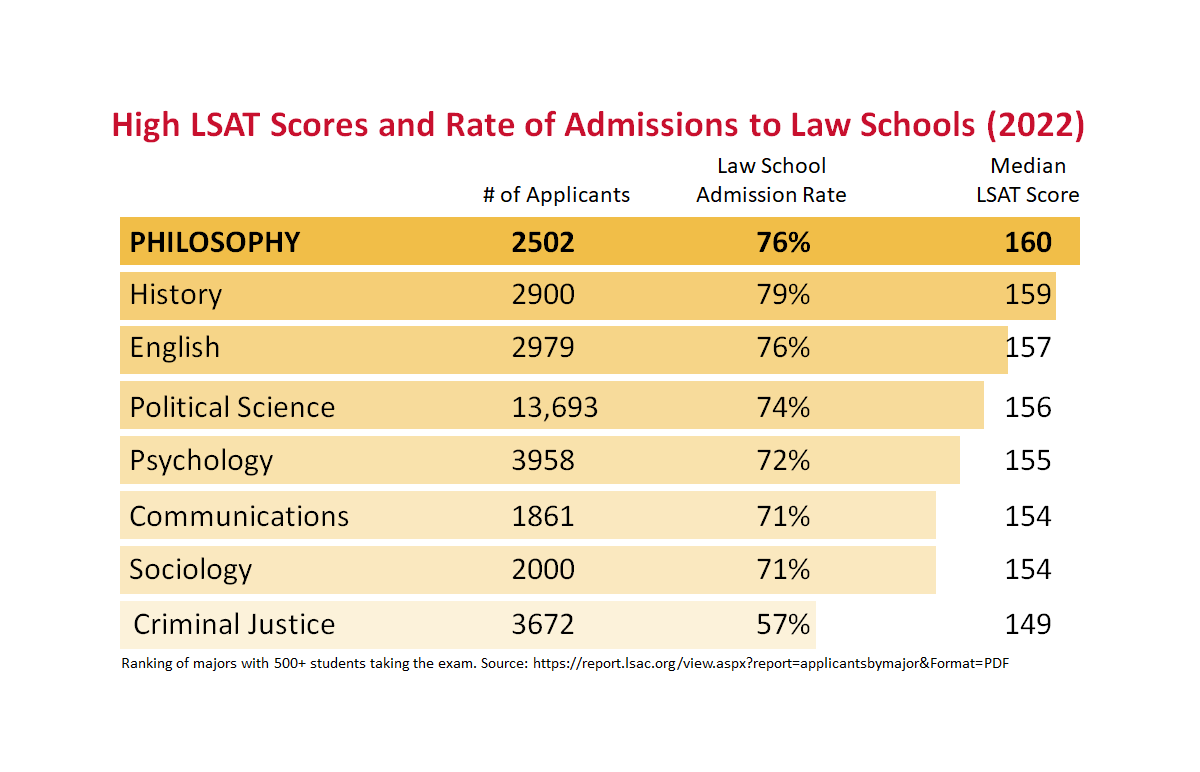
Law School

More than anything, law schools are looking for students who have acquired excellent analytic skills and who can present compelling arguments. For this reason, philosophy is widely regarded as excellent preparation for law school.

Medical School

The most recent available data show that philosophy majors are admitted to medical school at the second highest rate of all majors (50.2% admitted). The MCAT includes a “Critical Analysis and Reasoning Skills” section that requires students to analyze, evaluate, and apply information provided in passages from a wide range of social sciences and humanities disciplines, including ethics and philosophy.

Business School

Businesses seek employees who are able to extract key information from dense reports, summarize the information clearly, and assess costs and benefits of alternative courses of action. These critical thinking skills prized by employers are developed in every philosophy course.

Religious Studies: Path to Many Careers

Employers can easily provide on-the-job training for particular skills, but not training in cultural literacy and critical thinking. A religious studies degree signals to employers that you possess strong cross-cultural communication skills, problem solving, and reading comprehension.

Studying Devotion Pays Off

Law School

Religious Studies majors are well positioned for law school. They have a powerful combination of GPA scores and LSAT scores that place them among the top performers.

Medical School

The MCAT includes a “Critical Analysis and Reasoning Skills” section that requires students to analyze, evaluate, and apply information provided in passages from a wide range of social sciences and humanities disciplines, including religion and ethics.

A Career in the Making

Here are just a few examples of the many careers pursued by our majors.

Philosophy career opportunities

  • Lawyer or Legal Analyst
  • Professor or Teacher (Philosophy or Related Subjects)
  • Ethics Consultant or Corporate Social Responsibility Specialist
  • Public Policy Analyst or Advisor
  • Business Consultant or Project Manager
  • Journalist or Writer
  • Researcher or Academic Scholar
  • Nonprofit Program Manager or Director
  • Government Official or Diplomat
  • Human Resources Specialist

Religious Studies career opportunities

  • Healthcare jobs: doctor, nurse, other medical professionals
  • Creative jobs: writing, entertainment, game development, marketing, communication
  • Educational jobs: Teaching, libraries, museums, public history
  • Service-oriented jobs: social work, nonprofits, philanthropy
  • Government jobs: State department, data science, administration
  • Internationally focused jobs: Business, international development
  • Hospitality jobs: tourism, recreation, guest services
  • Graduate & professional school: religious studies, area studies, medicine, law, theology, library and data science

Career Planning and Preparation

Looking for help in putting together the perfect resume or cover letter? Or maybe you are looking for an internship or even some mock interviews for an upcoming job? LAS Career Services can help you with all of these and more.