Why is Philosophy widely considered the premier pre-law major? Because it cultivates the exact skills demanded by the legal profession: rigorous analytical thinking, careful logical reasoning, and meticulous attention to textual detail.

Think like a lawyer

By constantly dissecting complex, abstract arguments and evaluating competing ethical and conceptual frameworks, philosophy majors learn to spot logical fallacies, navigate legal grey areas, and write with extreme precision. Lawyers use these skills to navigate ambiguity, interpret statutes, apply precedents, and build persuasive arguments for competing interpretations of justice and fairness.

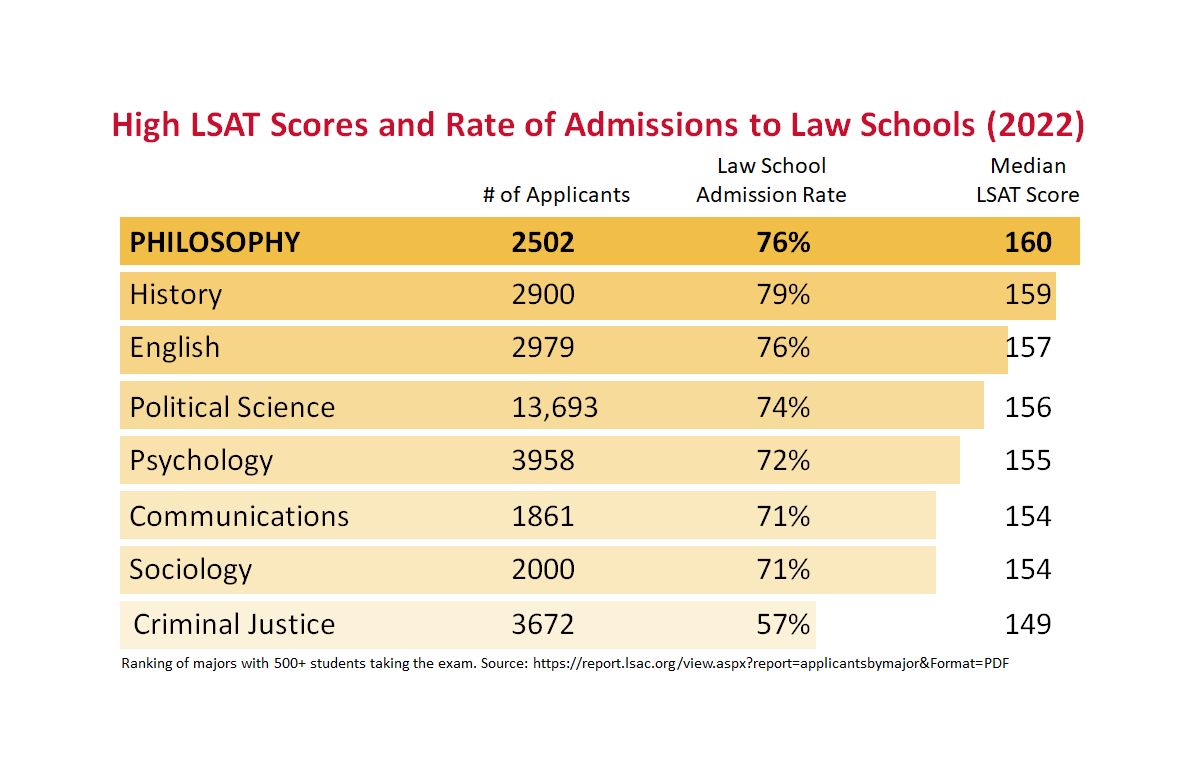
Chart showing that Philosophy majors score higher on the Law School Admission Test (LSAT) than other disciplines, including History, English, Political Science, Psychology, Communications, Sociology, and Criminal Justice. Data from 2022.

A leg up to law school

The comprehensive training of a philosophy major consistently translates into top-tier Law School Admission Test (LSAT) performance, high law school admission rates, and the intellectual agility required to excel in law school and legal practice.

Photo of Kay Gicquel

My philosophy degree prepared me extremely well for the LSAT exam since it is based on logic. Being logical in order to form and argue an opinion is a skill that I use on a regular basis and is the reason I finally realized that becoming an attorney was what I wanted to do. The ability to decipher what is true/best and to back up your statements with reasoning is essential. Overall, philosophy taught me the importance of thinking independently, discovering the truth and advocating for what is right.

Kay Gicquel, ’22 (Philosophy and Psychology, with minor in Religious Studies), currently studying law at the University of Iowa

Courses that actually prepare you for law school

  • PHIL 3220: Legal Reasoning and Jurisprudence. Examine how courts interpret and apply the law, with focus on criminal and tort law. How does legal reason address broader social issues, including medicine, sexuality, workplace, or environment?
  • PHIL 3320: Philosophy of Law. What is the law? Study theories of statutory and constitutional interpretation, fundamental legal and constitutional rights, and the connection between law and metaphysics, ethics, and political philosophy.
  • PHIL 3340: Environmental Ethics. What is the proper relationship between human beings and nature? Topics include human overpopulation, species extinction, forest and wilderness management, and pollution.
  • PHIL 3390: Liberty & Law in America. What is “liberty”? Examine liberty in political philosophy, American history, and U.S. Constitutional law. Explore problems and prospects for achieving a free, equal, and just American society.

  • PHIL 2010: Introduction to Philosophy. Big questions. Real skills. Explore mind, identity, truth, and reality. Emphasizes argumentation skills: identify arguments, evaluate evidence, raise and respond to objections, find possible consensus or deal-breakers.
  • PHIL 2060: Introduction to Logic and Scientific Reasoning. Think better by improving your belief-forming processes and cognitive virtues. Avoid cognitive biases and fallacies. Especially useful for problem-solving, analysis, or persuasion.
  • PHIL 2070: Introduction to Symbolic Logic. Use symbolic notation and logical methods to evaluate the goodness of arguments without rhetoric’s distracting features. Especially helpful preparation for LSAT.
  • PHIL 3220: Legal Reasoning and Jurisprudence. Examine how courts interpret and apply the law, with focus on criminal and tort law. How does legal reason address broader social issues, including medicine, sexuality, workplace, or environment?
  • PHIL 3660: Knowledge, Rationality, and Evidence. What is knowledge? How is it connected to evidence? When should we be skeptical of an AI-generated answer? When is it rational to rely on AI?

  • PHIL 2350: Ethical Issues in a Diverse Society. Examine challenges that arise from a diverse population, including: political polarization, racism, sexism, religion, and democratic deliberation.
  • PHIL 3300: Morality and the Good Life. Why be moral? How should we live our lives? What principles should we adopt? Classical texts guide discussion of practical reasoning, emotions, virtue, happiness, and flourishing.
  • PHIL 3350: Social and Political Philosophy. Philosophical exploration of state sovereignty, international relations, and global justice. What motivates states and shapes the international order? What role do human rights play in global politics? What are the responsibilities of non-state actors, such as multinational corporations?
  • PHIL 4300: Moral and Political Thought. Are value judgments based in reason or in emotion? Is moral responsibility consistent with brain science? How do situational factors and the social world shape our judgments and actions?
  • PHIL 4350: Contemporary Political Philosophy. How do AI and technology relate to politics? Do they enhance or undermine democracy or authoritarianism? What are legitimate uses? How should governments regulate or provide oversight of them?

Want to learn more?